
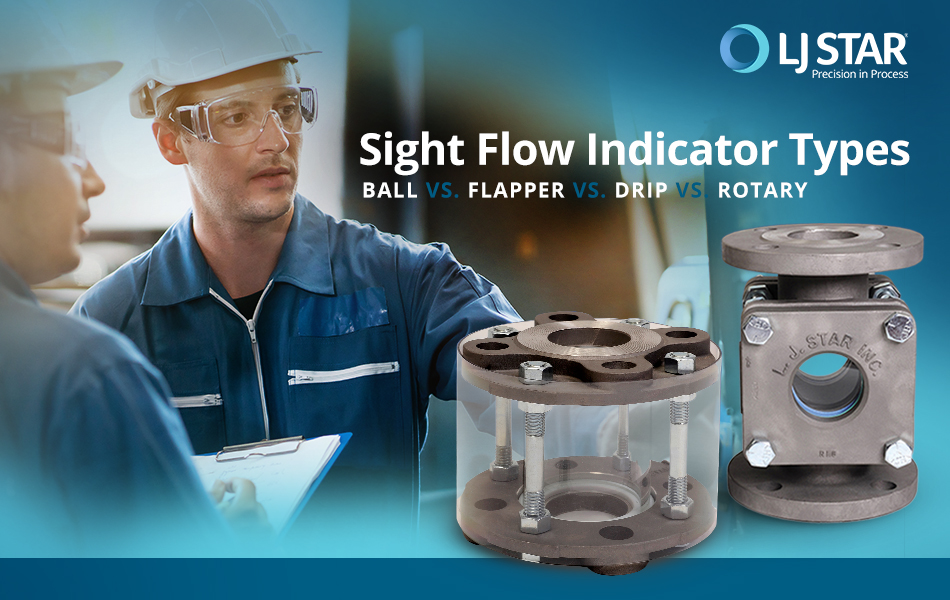
Every process line has a story to tell. A sight flow indicator is where you read it. It won’t put a number on the flow, but one glance shows you whether fluid is moving the way it should or whether something upstream has gone wrong. Sight flow indicators give operators that read at a glance, which makes them invaluable for confirming a process or catching a measurement device that has stopped reading.
The indicator style inside a sight flow indicator decides whether you actually see your flow. A ball style indicator suits simple upward or horizontal flow. A flapper suits one-direction horizontal lines. A drip indicator suits slow downward flow, and a rotary indicator handles nearly anything. Match the style to your flow direction and rate, or you end up staring at a window that tells you nothing. Here is how the four indicator types compare and where each one belongs.
Ball
The fluid’s flow moves a ball against a stop, and with more flow moves it farther. It is a straightforward check that flow is present, ideal for intermittent flow applications, and best on clean liquids in smaller lines with upward or horizontal flow. Because the ball moves on very little flow, it is the right pick for the lowest flow rates, where a heavier indicator would not budge. It is low cost and easy to read at a glance.
The tradeoffs: dirty fluids and solids can jam the ball, and it tells you movement rather than rate.
One sourcing note: LJ Star offers the ball style as a Teflon ball in its full-view, tube-style indicators, not in the standard cast bodies, so plan around that if a ball is what your low-flow line needs.
Flapper
Flow pushes a hinged flapper open, so visible motion confirms flow, and a graduated scale can turn the flapper position into an approximate gauge of volume. It shines in moderate-flow lines where you want obvious movement to watch.
Two things to plan for. It reads in a single direction, so it must be installed with the flow, and it is usually a horizontal-line device or installed with an upward flow. LJ Star indicators carry arrows marking the direction of flow so installation is unambiguous. Second, a flapper needs a minimum flow to lift its steel vane, more than most buyers expect, so it is the wrong call for a trickle.
Over time the hinge wears, and sticky or solids-laden products are not a good fit.
Drip
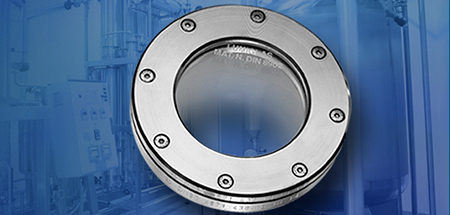
The drip style is for slow, heavy, low-flow rate applications with the flow moving straight down. A drip tube channels fluid to the center of the window so you see distinct droplets instead of product clinging to the walls and hiding the flow. Condensate and lubrication lines are classic use cases.
Push high flow through a drip indicator and the window simply fills, leaving nothing visible to move. Keep it to the low, gravity-fed service it was made for.
It works with thick, dark fluids.
Rotary
An internal rotor spins as flow passes, giving the most visible indication of the four along with direction and a rough sense of speed. Its real advantage is flexibility: it runs in any orientation and in either direction, which is why it is the most requested style by a wide margin. The one limit is at the bottom of the range, where very low flow may not carry enough energy to turn the rotor.
Mind the first-indication flow rate
Every mechanical indicator needs a minimum flow to move, and this trips up more selections than any other factor. An object at rest tends to stay at rest, so a light trickle may not overcome a rotor’s inertia.
The styles differ in how much flow they need before they register: a ball moves on the least, a rotor needs enough energy to spin, and a steel flapper needs the most, on the order of 22 liters per minute (5.8 gallons per minute) in the case of LJ Star’s flapper indicator. Give that flapper only a few liters per minute and it stays put, even with fluid clearly passing through.
Larger pipe diameters need more flow volume to reach that first indication. If your line runs too slowly to move the indicator, one fix is to route a smaller parallel line and place the indicator there. Our Guide to First-Indication Flow Rates lays out the volumes and velocities by pipe size.
Three mismatches to avoid
All three of these application tips come straight from the field. One customer chose a flapper unit for a very low-flow line, and the rotor never turned, so it was swapped for a rotary indicator.
Another ran a drip indicator on a fast top-to-bottom line, and the high flow filled the unit so completely that nothing appeared to move.
A third specified a plain view-through window for a clear fluid, and at full flow the window looked identical to an empty line, so there was no way to tell whether anything was moving. Clear fluids need an actual indicating element, such as a ball, flapper or rotor, to register flow.
In each case the product was sound. It was matched to the wrong flow or the wrong fluid.
One more advantage
LJ Star’s smaller sight flow indicators are investment cast in the United States, which matters on US government and US-preference projects where domestic manufacture affects both sourcing and delivery.
Check with an expert
Not sure which style fits your line? Send an LJ Star Application Expert your flow direction, rate, pipe size and what you are running, and you will get a recommendation before it becomes a purchase order.

Subscribe to our Blog

Categories
Certifications
Company
Goetze Safety Relief Valves
In The News
Industry Information
METAGLAS® Sight Glasses
PackExpo 2020
Sanitary Clamps
Sanitary Fittings
Sight Flow Indicator Benefits
Sight Glass Applications
Sight Glass Construction
Sight Glass Lighting
Sight Glass Lights
Sight Glass Process Vessel Camera
Sight Glasses
Trade Shows
Webcast