
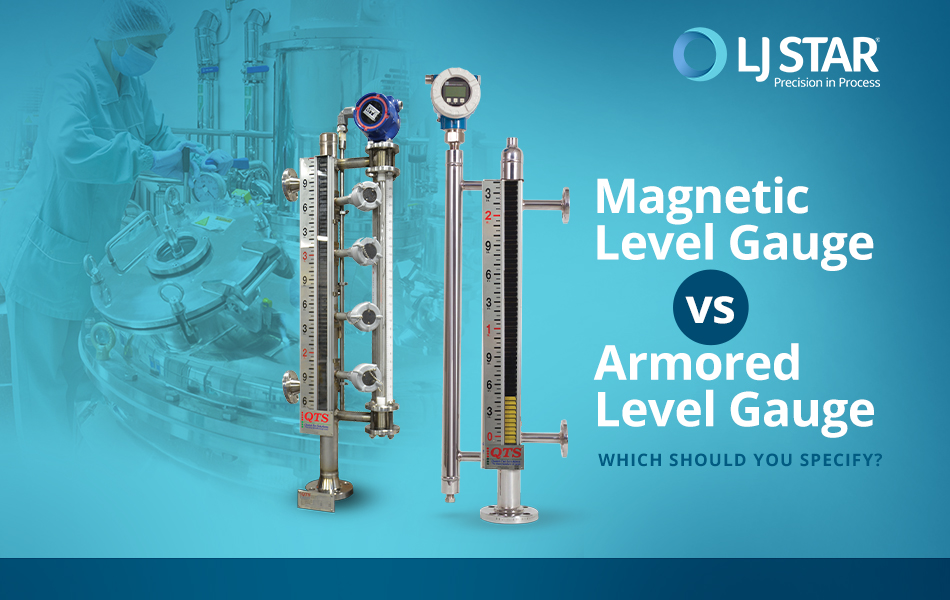
Choose a magnetic level gauge when safety and low maintenance come first. Choose an armored level gauge when you need to see the fluid itself. A magnetic gauge keeps the process sealed inside a metal tube with no glass in the fluid path. An armored gauge puts heavy glass between you and the process so you can read color, clarity and interfaces directly.
How a magnetic level gauge works
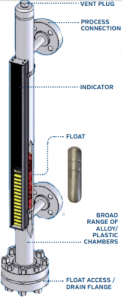
In a magnetic level gauge, also called a magnetic level indicator, a float carrying permanent magnets rides the liquid level inside a non-magnetic metal tube mounted vertically on the outside of the process vessel. The tube is connected to the vessel at the top and bottom. Because the level of the fluid in the tube matches the level of the fluid in the vessel, the float indicates the fluid level inside the vessel. Outside the tube, a high-contrast indicator, usually two-color flags on a large scale, locks magnetically to the float and moves with it. Read more on this topic.

Why plants specify magnetic level gauges
For many applications, safety is a prime concern. A magnetic level gauge has no glass that can break. If the external indicator is struck by passing personnel or equipment, the process fluid stays contained inside the metal tube. A magnetic gauge is the natural choice for toxic or flammable fluids, very high pressure, elevated temperature and anywhere glass breakage would be a hazard.
The maintenance case is nearly as strong. There is no glass to replace, no gauge-glass gasket set to maintain and no gradual clouding of the glass, so little maintenance is required. Magnetic gauges accept transmitters, switches and alarms easily, which suits remote monitoring. Also, the colored flags are easy to read from a distance across a plant floor.
Where armored level gauges are used
Armored level gauges are made of metal and glass. When direct visual observation is essential to the process, an armored level gauge is the better choice.
With an armored gauge, the operator observes the fluid level directly. There is no float to interpret. Readings are confidently reliable.
Armored level gauges come in two types. Reflex gauges use glass with molded prisms on the process side so liquid reads as a sharp black band against a bright vapor space, viewable from yards away. Transparent gauges use flat clear glass so operators can examine the color of the process fluid and the interface between the liquid and gas/air. That is exactly what operators need to see for oil-water separation, condensate service and any process where seeing separation, color or clarity matters more than reading a level.
In applications with chemicals that may corrode glass, transparent gauge glass can be fitted with optional shields made of mica or PCTFE. Reflex glass cannot be shielded because the glass is not flat.

Where floats fall short
A magnetic gauge is only as good as its float, and floats have limits. A fluid with specific gravity too low for the float to track, a changing density, coating or buildup forming inside the tube, viscous liquids or solids that make the float stick can compromise the reading. In those conditions, an armored gauge may provide a more dependable visual reading because there is no moving float to fail. Some plants run an armored gauge alongside a magnetic one as a secondary visual check, confirming the primary gauge is indicating accurately.
How to decide which type of level gauge to specify
Specify a magnetic level gauge when you want safety with hazardous media, low maintenance and easy remote outputs, and when the risk of glass breakage must be eliminated. Specify an armored gauge when you need to see the color and condition of the process fluid or observe the separation with your own eyes, or when the characteristics of the process fluid could interfere with the travel of the float in a magnetic level gauge.
LJ Star offers both types of gauges in materials and configurations matched to your vessel, temperature, pressure and fluid. If you are weighing the two types for a specific service, an LJ Star Application Expert can point you to the right one before you commit to a specification.

Subscribe to our Blog
Categories
Certifications
Company
Goetze Safety Relief Valves
In The News
Industry Information
METAGLAS® Sight Glasses
PackExpo 2020
Sanitary Clamps
Sanitary Fittings
Sight Flow Indicator Benefits
Sight Glass Applications
Sight Glass Construction
Sight Glass Lighting
Sight Glass Lights
Sight Glass Process Vessel Camera
Sight Glasses
Trade Shows
Webcast