
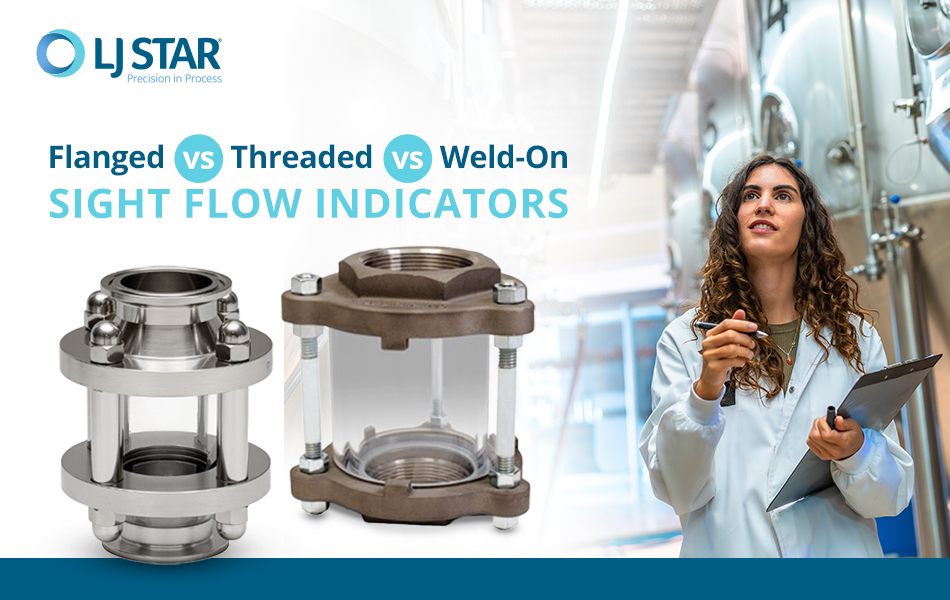
Every sight glass succeeds or fails at its anchor point. Usually the window gets the attention, but the mount determines what pressure it holds, what temperature it handles and whether you can install it at all. Three mounting styles cover most industrial sight glass installations: threaded, flanged (or bolt-on) and weld-on, and the right one comes down to a short list of questions about your tank, your process and where you are in the tank’s life.
Threaded units screw into a nozzle and hold the highest pressure in the smaller sizes. Bolt-on flanged units mount to an existing tank flange and inherit that flange’s pressure rating. Weld-on units attach to a pad welded into the tank and are the natural choice when the tank is still being built or the view needs to be large or non-round. Choosing the right one comes down to a short list of questions about your tank, your process and where you are in the tank’s life.
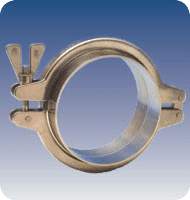
Truly sanitary or aseptic lines use a tri-clamp connection such as MetaClamp®, because sanitary processes avoid threads and exposed gasket paths. This guide focuses on the three industrial mounting styles.
How each sight glass style mounts
A threaded flow indicator is a male NPT thread turned into a matching nozzle. It is simple and compact and shows up most often in boiler service. It sits on the industrial side of the line, not sanitary, because sanitary processes steer clear of threads.
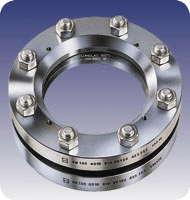
Bolt-on, or flanged sight flow indicator, mounts to a flange nozzle already on the tank. The flange is rated by class under ANSI/ASME B16.5, with classes 150, 300, 600 and 900 the most common, so its pressure and temperature limits are well documented. This is the practical answer when a tank is already in service and has a spare flange to mount to.
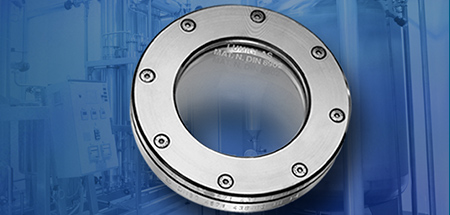
A weld-on sight flow indicator starts with a weld pad welded into the tank. The assembly then bolts to that pad and is typically made of five parts: the weld flange, a seal gasket, the glass, a cushion gasket and a retainer. Because the pad is welded in, these units are usually specified while the tank is being fabricated, which is why most of them are sold to tank fabricators.
Flow indicator mounting styles at a glance
| Consideration | Threaded | Bolt-on (flanged) | Weld-on |
|---|---|---|---|
| Installation difficulty | Low. Screws into a threaded nozzle, compact, few parts | Low to moderate. Bolts to an existing tank flange, no welding, but the tank must already have the flange | Highest. A pad is welded into the tank, roughly a five-part assembly, usually done during fabrication |
| Typical pressure ceiling | Highest in small sizes, up to 100 bar (1450 psi) through 2 in, near 725 psi at 3 in | Inherits the flange class rating (ANSI/ASME B16.5 class 150 to 900), low through high by class | Lower than a rated flange, the flat pad must be reinforced for higher pressure |
| Best-fit scenario | Smaller industrial ports and boiler service, not sanitary | Tanks already in service with a spare flange, larger or higher-pressure views | Tanks being fabricated, non-round or level views, very high-temperature windows |
| Relative cost | Among the most affordable (fused METAGLAS threaded) | Modest at class 150, rises sharply at class 900 | Wide range, low-pressure circular is inexpensive, DIN 28120 and non-round run higher |
Start with the connection, then work through the process
The first question is whether you already know the connection you need. Fabricators usually do. They know if they are welding a pad, bolting to a flange or fitting a ferrule. If you do not know, a handful of process details narrow it fast: shape, maximum temperature, maximum pressure, what you need to see, the size of the view and where the tank is in its life.
Where you are in the tank’s life
This factor is decisive and easy to overlook. If the tank is being fabricated, adding a weld-on pad is straightforward and economical. If the tank is already in service, welding in a new port is rarely practical, so a bolt-on or tri-clamp unit that fits an existing flange or ferrule becomes the realistic choice.
Pressure
From atmospheric up to roughly 16 bar (232 psi), any of the three mounting styles can work. Above that, the field narrows to threaded or bolt-on. LJ Star’s METAGLAS® threaded units actually hold the most pressure in the smaller sizes, up to 100 bar (about 1450 psi) through 2 inches, with 3-inch units rated near 725 psi.
Bolt-on units inherit their flange class rating, so a class 300 or class 600 flange covers many high-pressure cases.
A flat welded pad has to be reinforced to carry high pressure, so it is not the first pick when pressure runs high.
Temperature and the sight glass
METAGLAS borosilicate sight glass windows are rated to 572°F, and 536°F for continuous service.
If your process runs hotter, the window itself has to change to quartz, rated to roughly 1900°F, or sapphire, rated upward of 3000°F, and neither can be built as a fused METAGLAS window. That pushes very high temperature applications toward a weld-on mount, such as a DIN 28120 low-pressure assembly, or a bolt-on mount, and away from threaded METAGLAS sight glasses.
What you need to see, and how big
Where you place the window follows what you want to observe. To watch the overall process, foaming or color, a round window on the top tank head is typical.
To read a level or study something specific in the fluid, a rectangular or obround window on the side of the tank works better, and those non-round shapes cannot be threaded or bolted, so they are weld-on by nature.
Larger views, especially when you are adding a light, a camera or a wiper, mean a bigger sight glass, and the bigger connections tend to be weld-on or bolt-on.
Cost is not tied to the mount
There is no clean ranking of mount styles by price. A low-pressure circular weld-on is inexpensive, a DIN 28120 weld-on sits higher, and a bolt-on climbs from modest at class 150 to significantly more at class 900, where the flanges themselves get costly and harder to source.
Obround and rectangular sight glasses carry a premium because their non-round shape requires special machining rather than the simple spin-machining of a round unit.
It surprises people, but the fused METAGLAS threaded and MetaClamp windows are often among the most affordable options.
Get the details right before the PO
Most mounting mistakes can be caught before purchase by asking the right questions. Confirm who supplies the tank flange. LJ Star provides the bolt-on sight glass, not the tank flange it mounts to, and a buyer who assumes otherwise can be left unable to install the unit.
Not sure which mounting style fits your tank? Send an LJ Star Application Expert your shape, pressure, temperature and view size, and you will get a recommendation before it becomes a purchase order.

Subscribe to our Blog
Categories
Certifications
Company
Goetze Safety Relief Valves
In The News
Industry Information
METAGLAS® Sight Glasses
PackExpo 2020
Sanitary Clamps
Sanitary Fittings
Sight Flow Indicator Benefits
Sight Glass Applications
Sight Glass Construction
Sight Glass Lighting
Sight Glass Lights
Sight Glass Process Vessel Camera
Sight Glasses
Trade Shows
Webcast