
The LumiStar family offers unprecedented, penetrating illumination of vessels, up to four times brighter than a typical halogen luminaire. Depending on the model, a range of features are available, including automatic dimming, programmable control, and remote switching. All LumiStar LED lights are crevice free and washdown safe. Mount with bracket on the retaining ring of a standard sight window, or clamp mount over a sterile-style sight glass (dedicated light port).
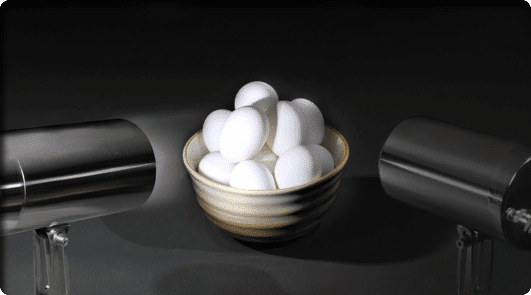 LED Lighting
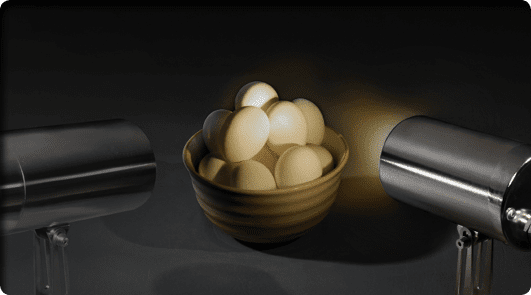 Halogen Lighting
LED vs Halogen
Frequently Asked Questions
What is process lighting?
Process lighting refers to purpose-engineered illumination systems designed to shine light into the interior of industrial vessels, tanks, pipelines, and reactors so that operators can visually observe what is happening inside. Unlike general facility lighting, process lights are mounted directly on or near sight glass ports, providing targeted, glare-free illumination that makes it possible to monitor mixing, flow, reaction stages, liquid levels and cleanliness. LJ Star’s LumiStar® LED process lights deliver up to 3,000 lumens, four times brighter than a typical 100W halogen light, to optimize operator visibility into their process vessels.
Lumiglas® explosion-proof lighting for hazardous environments also support clear, reliable vessel illumination and visual process observation across a wide range of industrial applications. Together, LumiStar® LED and Lumiglas solutions give operators more options to improve visibility, support safer monitoring and maintain better control of critical processes.
What is a sight glass light used for in industrial processes?
A sight glass light is used to illuminate the interior of a closed process vessel in industrial processes. Greater visibility enables operator inspection of real-time processes inside the vessel, whether that is monitoring agitation, verifying cleaning effectiveness, checking liquid color or clarity, observing reaction progress, or confirming fill levels. Process vessel interiors are typically too dark for useful observation without dedicated illumination, and a flashlight held to a sight glass creates problematic glare and rarely provides enough light. LJ Star’s Lumiglas® and LumiStar® process lights are engineered specifically to deliver targeted, glare-free illumination through sight glass ports in pharmaceutical, chemical, food and beverage, and other demanding industrial environments. Auto dimming prevents overheating and programmable controls facilitate remote operations.
What types of sight glass lights are available for process vessels?
Several types of sight glass lights are available to suit different process conditions and vessel configurations. Older halogen lights, selected by wattage, typically in the 5 to 100 watt range, are being replaced with LED lights. LED lights offer greater brightness, lower energy consumption, and longer service life. Fiber optic lights route illumination through a flexible cable, allowing the light source to be located away from the vessel, which is useful for tight spaces, vibrating equipment or heat-sensitive processes.
Explosion-proof versions of all these types are available for hazardous locations. LJ Star offers the full spectrum of LED lights, including the LumiStar® 1000, 2000, and 3000 LED series for non-hazardous applications and the Lumiglas® Ex-Light series, for classified hazardous environments.
How do I select the right light for my sight glass?
Selecting the right sight glass light starts with three key factors: the hazard classification of your environment, the size of your light port and the amount of illumination needed based on vessel size. Larger tanks require higher lumen output, pharmaceutical applications may need precise color temperature control and tight or hard-to-reach ports may call for a fiber optic solution. Whether the process is sanitary, high-pressure or located in a classified area will further narrow the options.
LJ Star has published a free Sight Glass Lighting Handbook that walks engineers through these criteria step by step. Their LumiStar® LED series offers tiered output matched to vessel size, while the Lumiglas® Ex-Light series addresses hazardous location requirements, making it straightforward to find the right fit for almost any application.
What is the difference between a sight glass and a sight glass/light combination unit?
A conventional sight glass installation uses two separate ports on a vessel: one for viewing and a separate one for the light source. A sight glass/light combination unit integrates both the observation window and the light into a single port assembly, eliminating the need for a second port and reducing vessel fabrication costs. This fixes the illumination angle and pairs up the light source with the glass port.
LJ Star offers the Lumiglas® View/Light Combo Series SKS as well as the LumiStar® Sight/Light Port Combo for DIN 28120 series assemblies. These give engineers a compact, cost-effective option where two-port configurations are impractical.
Can LED lights be used on sight glasses in sanitary or food-grade applications?
Yes, LED lights are well-suited for sanitary and food-grade process applications and are increasingly the preferred choice. They produce no ultraviolet output that could degrade gaskets, generate minimal heat that might affect temperature-sensitive processes and feature crevice-free designs that support hygienic cleaning. LEDs also last significantly longer than halogen bulbs, reducing the frequency of maintenance interventions in clean environments.
LJ Star’s LumiStar® LED series lights are washdown safe, rated IP65, crevice-free and available with capacitive switches. They are ideal for pharmaceutical, food and beverage, and craft brewing applications where hygiene and reliability are paramount.
Do sight glass lights work in high-pressure or high-temperature environments?
Sight glass lights mount to the exterior of the vessel and do not contact the process media, so they are not directly subject to process pressure. The sight glass assembly through which they illuminate must be rated for the application’s pressure and temperature, and the light itself must be matched to the ambient operating temperature at the vessel exterior. In hot environments, LED technology with auto-dimming or thermal management features perform better than the prior halogen generation of lighting to prevent heat-related failure.
LJ Star’s Lumiglas® Ex-Light series is constructed from corrosion-resistant die-cast aluminum alloy and engineered for demanding industrial conditions. Its METAGLAS® Safety Sight Windows, the world’s number one selling fused sight glass, are rated for high-pressure and high-temperature service and, when paired with the appropriate Lumiglas® light, provide a complete and reliable observation solution.
What is fiber optic lighting for sight glasses, and when is it used?
Fiber optic lighting for sight glasses works by generating light from a remote source and transmitting it through a flexible fiber optic cable to the sight glass port. This produces “cold light” at the point of illumination because heat from the bulb stays with the remote housing, making it suitable for temperature-sensitive processes. It is also the preferred solution when a light port is too small for a conventional fixture or when the light source must be kept away from vibrating equipment to extend bulb life.
LJ Star’s Lumiglas® Lumiflex™ fiber optic sight glass and light combo allows the light source to be positioned up to five feet from the vessel. It offers UL ratings and a cable diameter small enough to fit into and illuminate a single shared port.
What is the difference between explosion-proof lighting and standard hazardous location lighting?
“Hazardous location lighting” is the broad category covering any fixture designed for environments where flammable gases, vapors or combustible dust may be present. “Explosion-proof lighting” is a specific subset in which the fixture’s housing is engineered to contain any internal ignition, preventing flames or sparks from escaping and igniting the surrounding atmosphere. Not all hazardous location lighting is explosion-proof; some fixtures rely on sealed or non-incendive designs, a recognized protection technique used for Class I, Division 2 and Class II, Division 2 locations, where the hazardous atmosphere is only expected to be present under abnormal conditions.
LJ Star’s Lumiglas® Ex-Light series represents true explosion-proof lighting, environmentally sealed and shock-proof. It is rated for Class I, Division 1 and 2 service and is appropriate for the most demanding hazardous process environments in chemical, industrial and oil and gas industries.
What certifications should I look for in process lighting for hazardous areas?
For process lighting in hazardous areas in North America, the most common certifications to verify include UL listing under UL 844 for luminaires in hazardous locations and CSA certification for Canadian applications. ATEX certification is required for European Union facilities, while IECEx is recognized internationally. The fixture marking should specify the Class, Division or Zone, and Group for which it is approved, along with its temperature classification confirming its maximum surface temperature stays safely below the ignition point of the gases or vapors present.
Not all suppliers provide independent third-party documentation for their certifications, but LJ Star does. Its Lumiglas® USL08LED-EX explosion-proof LED light carries UL 844 listing for Class I, Division 1 and 2, Groups C and D, UL 1571 wet-conditions approval, and an IP65 rating for dust and waterjet tight protection, with verifiable compliance documentation available at ljstar.com.
What is the difference between Class I Division 1 and Class I Division 2 lighting?
The distinction between Class I Division 1 and Class I Division 2 lighting comes down to how often a flammable atmosphere is expected to be present. Division 1 locations are those where ignitable concentrations of flammable gases or vapors exist continuously, intermittently or periodically under normal operating conditions, requiring fixtures that can physically contain an internal explosion. Division 2 locations are those where flammable materials appear only under abnormal conditions such as an equipment failure, allowing for lighter and less costly fixture designs that must be proven unable to cause ignition but are not required to contain one.
A Division 1 fixture can always be used in a Division 2 location, but the reverse is not permitted. LJ Star’s Lumiglas® Ex-Light series USL08LED-EX is UL 844 listed for both Class I, Division 1 and 2, giving facilities in either hazard category a single certified lighting solution they can deploy with confidence.