
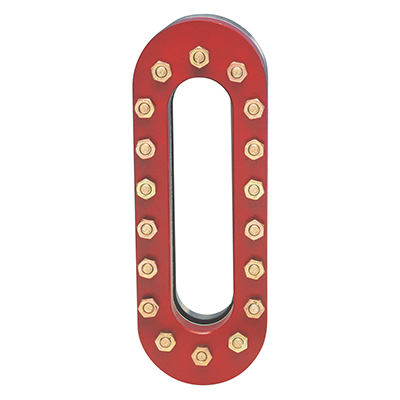
Obround Sight Glass Assembly, Weld-On
Obround Level Gauge Glass for Sight Indication
The obround weld-on sight glass can be welded into a pipeline or vessel for accurate flow or level indication.
Request a Quote
Request a QuoteObround Sight Glass Assemblies
A round sight glass shows a general view of the process, specifically when installed on a tank head. When level, foam, a phase boundary, or a CIP cycle moves across a range instead of sitting still, that single point stops being enough. LJ Star’s obround sight glass assemblies replace the fixed point with a wider, taller field of view, welded directly onto the vessel and engineered around the process it’s watching.
How It’s Built
An obround window is an elongated port with rounded ends, welded through a weld pad rather than bolted through a flange. Because an elongated shape can’t be fused the way a round window can, each assembly uses a gasketed glass retainer that holds tempered borosilicate, or another specified glass, against the weld pad and cover flange with threaded studs and nuts. That construction is rated up to 150 PSIG at 500°F, depending on the gasket material specified.

Features
– 13 standard assemblies, from 1 to 4 inches wide and 6 to 24 inches long, plus custom configurations built on the same schedule as a standard unit
– Weld pad specified flat or curved to match the vessel’s actual diameter for a flush, low-stress fit
– Radiused weld pad corners available for rubber-lined vessels, protecting the lining from a square-corner stress point
– Construction in 316L stainless steel, carbon steel, or Hastelloy for aggressive media
– Gaskets in EPDM, Gylon 3504, silicone, PTFE, or non-asbestos material
– Glass options: tempered borosilicate standard, quartz for high-temperature or thermal-shock service, acrylic for water service
– Optional internal wash nozzles reaching the full length of the window, including corners
– Optional glass protection shields for harsh or abrasive environments
Benefits
A single obround window shows level movement, a rising foam line, or a shifting phase boundary continuously, through one opening, instead of committing to a fixed elevation or welding a second and third round port up the wall. It confirms a CIP cycle is washing the full height of the sidewall, not only the area nearest the spray nozzle. And because it’s a passive visual instrument, it adds this without a sensor, a transmitter, or a control point: nothing to calibrate, no signal to wire, no added hardware to fail.
Built for the Vessel, Not the Shelf
LJ Star designs each obround assembly around the actual vessel rather than shipping a fixed catalog part. The weld pad geometry, corner radiusing, gasket, and glass are specified to the application before the unit is built, which is what keeps a custom configuration on the same build schedule as a standard one.
Ratings and Limits
Obround assemblies are rated up to 150 PSIG at 500°F, depending on gasket material. Above that pressure or temperature, or on a vessel without wall space for an elongated port, a round, fused sight glass such as LJ Star’s METAGLAS® window is the correct choice instead.
Talk to an Applications Engineer
Every obround sight glass is sized and specified to the vessel it’s welded to. Contact an LJ Star applications expert to design one around your process.
Obround Weld Pad Gages
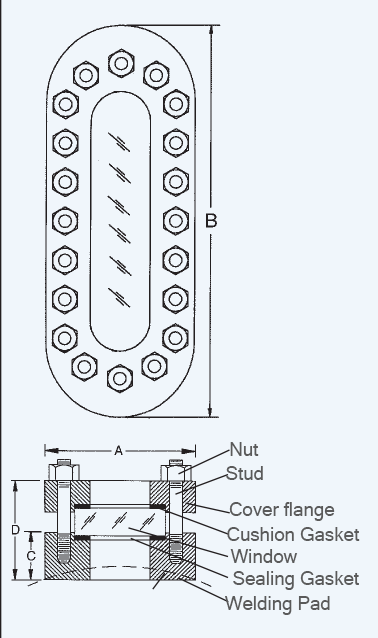
Note: A reuseable weld spacer is recommended during welding to prevent distortion.
Rated to 150 PSIG @ 500ºF (1034 kPa @ 260ºC)
| Model No. | View Size (± 1/8″) |
Outside Pad Dimensions (± 1/8′) | ||||||||
|---|---|---|---|---|---|---|---|---|---|---|
| Width A |
Length B |
Thick. C |
A.O.H. D |
|||||||
| Inches | (mm) | In | (mm) | In | (mm) | In | (mm) | In | (mm) | |
| OBWP1-12 | 1 x 12 | (25 x 305) | 3.5 | (89) | 15.5 | (394) | 1.2 | (30) | 3.3 | (84) |
| OBWP2-6 | 2 x 6 | (51 x 152) | 5 | (127) | 10 | (254) | 1.5 | (38) | 3.8 | (97) |
| OBWP2-12 | 2 x 12 | (51 x 305) | 5 | (127) | 16 | (408) | 1.5 | (38) | 3.8 | (97) |
| OBWP2-18 | 2 x 18 | (51 x 457) | 5 | (127) | 22 | (559) | 1.5 | (38) | 3.8 | (97) |
| OBWP2-24 | 2 x 24 | (51 x 610) | 5 | (127) | 28 | (711) | 1.5 | (38) | 3.8 | (97) |
| OBWP3-6 | 3 x 6 | (76 x 152) | 6 | (152) | 11 | (279) | 1.5 | (38) | 3.8 | (97) |
| OBWP3-12 | 3 x 12 | (76 x 305) | 6 | (152) | 17 | (432) | 1.5 | (38) | 3.8 | (97) |
| OBWP3-18 | 3 x 18 | (76 x 457) | 6 | (152) | 23 | (584) | 1.5 | (38) | 3.8 | (97) |
| OBWP3-24 | 3 x 24 | (76 x 610) | 6 | (152) | 29 | (737) | 1.5 | (38) | 3.8 | (97) |
| OBWP4-6 | 4 x 6 | (102 x 152) | 7 | (176) | 11 | (279) | 1.5 | (38) | 3.8 | (97) |
| OBWP4-12 | 4 x 12 | (102 x 305) | 7 | (176) | 17 | (432) | 1.5 | (38) | 3.8 | (97) |
| OBWP4-18 | 4 x 18 | (102 x 457) | 7 | (176) | 23 | (584) | 1.5 | (38) | 3.8 | (97) |
| OBWP4-24 | 4 x 24 | (102 x 610) | 7 | (176) | 29 | (737) | 1.5 | (38) | 3.8 | (97) |
Fabrication Note: It is the vessel fabricator’s responsibility to verify that the weld pad offers sufficient reinforcement for their particular application.
Options include flat gasket seat and rounded inside corners for rubber lining, internal wash nozzles, outer safety shield, custom size view, special materials, etc.
Standard Materials
| Part | Standard Materials |
|---|---|
| Nut | SA194 2H Zinc plated alloy steel |
| Stud | SA193 B7 Zinc plated alloy steel, B8, B8M Class 2 SS |
| Cover Flange | SA516-70, SA240, T304, T316 |
| Cushion Gasket | Compressed Non-Asbestos Fiber |
| Window | Tempered Borosilicate Glass |
| Sealing Gasket | EPDM*, Viton*, Silicone Rubber*, PTFE |
| Welding Pad | SA516-70, SA240, T304L, T316L |
*recommended gasket material
Frequently Asked Questions
Q: What is an obround sight glass?
An obround sight glass is an elongated viewing window with rounded ends, welded to a vessel through a weld pad instead of bolted through a flange. The stretched profile opens up a taller and wider field of view than a round port. That extra viewing area is the point of the shape: it lets you watch conditions that move across a range, such as a rising and falling liquid level, foam developing on a batch or a phase boundary shifting during separation, all through one opening rather than a stack of round ports.
LJ Star builds its obround assemblies on weld-pad construction, so the window integrates into the vessel wall through the weld pad rather than standing off on a bolted flange. It offers 13 standard sizes from 1 to 4 inches wide and 6 to 24 inches long, and LJ Star fabricates custom lengths when the observation range falls between standard units. Because the assembly is welded in rather than clamped, it suits fixed process vessels where a permanent, large-area sightline is worth more than the quick removability of a bolt-on window.
Q: What is the difference between a round and an obround sight glass?
A round METAGLAS® sight glass is fused into a metal ring. The construction works because compressive force distributes evenly around a circle, which holds the glass in radial compression and lets it carry high pressure and temperature. That geometry does not translate to an elongated shape, so an obround window uses a gasketed glass retainer instead: the glass is held against a weld pad and cover flange with threaded studs and nuts. The practical difference is rating against viewing area. A fused round window like LJ Star’s METAGLAS® carries far higher pressure and temperature, up to 572°F on select models, while an obround assembly trades some of that headroom for a much larger sightline, rated up to 150 PSIG at 500°F depending on gasket material.
The choice comes down to what the process demands. High-pressure reactors, steam service and aggressive chemical duty call for the fused round construction. Large-area level and process observation on lower-pressure vessels is where the obround shape earns its place. LJ Star carries both, so the same Application Expert can spec a METAGLAS® round window for the high-pressure leg of a system and an obround window for the observation vessel, with third-party documentation provided for the ratings on each.
Q: What pressure and temperature can an obround sight glass handle?
An LJ Star obround sight glass is rated up to 150 PSIG at 500°F, with the exact ceiling set by the gasket material specified for the service. Gasket selection is the governing variable, because the glass is sealed against the weld pad and cover flange rather than fused into a compression ring, so the elastomer or PTFE compound has to hold the seal across the full operating temperature. Process conditions above that range need a round, fused sight glass rather than an obround assembly.
This is where LJ Star’s dual portfolio matters. When an application runs hotter or at higher pressure than an obround window supports, the METAGLAS® fused line steps in with a wider operating envelope, and LJ Star will provide independent third-party documentation of the pressure and temperature ratings on request. Rather than force one construction to cover every case, LJ Star matches the recommendation to the duty so the observation point is rated correctly for the process.
Q: How do you clean an obround sight glass?
The elongated shape rules out a rotating wiper, which is the usual mechanical cleaning method on round windows. Obround assemblies are instead specified with internal spray nozzles positioned to reach the full length of the window, including the corners where residue and film tend to collect first. In many installations, routine process flow and washdown cycles already carry fluid across the glass, which can stretch the interval between scheduled cleanings.
LJ Star sets the spray nozzle layout to the window dimensions so coverage extends corner to corner rather than only across the center of the sightline. For processes prone to fouling or hardened deposits, LJ Star’s Application Experts can advise on nozzle placement and cleaning approach, since a window you cannot see through is a failed window regardless of how well the glass itself is rated. Matching the cleaning method to the shape at the specification stage avoids the common problem of an obround window that hazes over in a spot no fixed nozzle reaches.
Q: What sizes do obround sight glasses come in?
LJ Star maintains 13 standard obround assemblies, spanning 1 to 4 inches wide and 6 to 24 inches long. That range covers most level and process observation needs, from a narrow window tracking a single level band to a long window following a phase boundary or a wide fill across a large vessel. Width and length are chosen around the observation range, not only the vessel opening, so the sightline frames what the operator actually needs to watch.
When a standard size does not fit the application, LJ Star builds custom configurations, typically on the same delivery schedule as a standard unit. That in-house fabrication is the practical advantage of specifying obround windows through LJ Star: the assembly is sized to the process rather than limited to a fixed catalog, and the custom unit carries the same construction and documentation as the standard line.
Datasheet - Obround Level Gauge Glass for Sight Indication
Obround IOM
Important Guidelines
How to Ensure Sight Glass Safety - Tutorial
How to Select and Maintain Sight Glasses for Chemical and Pharmaceutical Applications
Beyond the Round Port: When and Why Obround Sight Windows Improve Process Visibility
Choosing the Right Sight Glass for Visibility and Cleanability
From Observation to Optimization: Using Obround Sight Glasses to Monitor Flow, Level and Cleaning Efficiency
Welded into a vessel or a pipeline, these rugged fittings provide either flow or level indication. They are available in carbon steel, stainless steel and special alloys. Obround visible glass sizes range from 1 to 4″ in width and 6″ to 24″ inches in length, and are suitable for ASME code requirements. Custom designs are also available; inquire with your local representative or L.J. Star expert.